RSS Feed Follow us on Twitter

« Yahoo China, Yeah, That's The Ticket | | China's New Labor Law -- It's A Huge Deal. Huge I Tell You. »

I Heart China's Legal System (Part II). A Bit Less This Time.

Posted by Dan on November 9, 2007 at 07:58 AM

David Dayton, China business consultant extraordinaire, and

part-time blogger, wrote me an email with all kinds of follow up questions to my post, "I Heart China's Legal System," which arose out of a Steve Dickinson article in Business Week in which Steve went after five common myths regarding China's legal system.

Dayton's post is entitled, "Legal Myth Busters in China," and it includes my response to his emailed questions. Please excuse the informality as I had no idea my response would show up online:

Heard them all many times and all have at least a grain of truth to them. Here goes:

1. Courts are not independent. Whether you win or lose in court could be up to the people that the court is connected to. Many govt. officials are involved in "private industry." It may not matter if all your legal ducks are in a row if the other side has better guanxi. True or not?

True, but the farther away one gets from the local officials (i.e., appeals), the less likely this is to be true.

2. The legal system is getting better all the time but enforcement is still so poor that it may not matter. Even if you win, so what? Maybe you can stop one offense, but if there is money in it another will pop up (or may already have). True or not?

True, but part of this is that Chinese courts are just learning about things like fraudulent transfers and piercing the corporate veil. I have had many discussions on these issues with Chinese lawyers (because this is an issue in which I have a lot of experience and interest) and they tell me that we lawyers need to keep working on the judges on this and things will continue improving. I believe this. I argued and lost (through my Korean lawyers) the piercing the corporate veil doctrine in Korea so many times that I actually think it was my arguments that finally led Korea to institute a piercing the corporate veil law. China already has one, but it is going to take a while before it becomes truly effective.

3. IPR protection/enforcement is really the domain of politics rather than courts. Case in point: The Olympics. The fact that they can enforce IP on issues that are of ($) value to the State shows that IPR is still a political rather than legal issue, at least some of the time. Economic development of China is still a more important issue than international IPR. True or not?

Mostly False. You are combining two things here. I agree that enforcement of IPR outside the courts is mostly political, but if you bring your own civil suit to enforce IPR in China, your chances are not half bad.

4. Because China is process rather than precedent based system if someone else files paperwork for your trademark/patent/etc. you are basically out of luck. China is not the only country that works like this, I know, but as "the world's factory" and the largest source of black market goods it's a huge issue here. True or not?

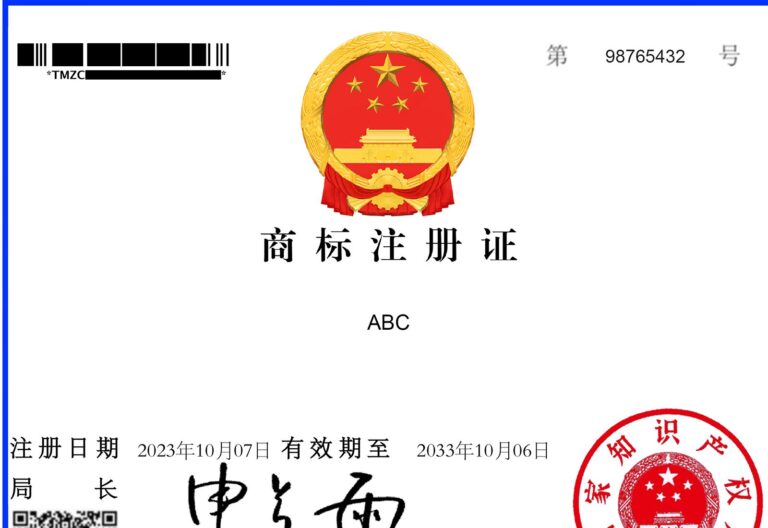
Half true, half false. This is a huge, huge issue and it is usually the very first issue I raise with every new client. It is mostly a huge issue for North Americans (which is where most of our client base comes from) because things are the exact opposite here. There is absolutely nothing wrong with China's IP laws as they are (I am told) very similar to many EU countries. They are very different from US laws and so US companies tend to get burned. The US, for instance, says the first to use a trademark gets it while China (and most other countries) say the first to file for it gets it. I do not think one system is necessarily better than the other, but in the first to file system you sure as hell better know about it or you run massive risks. We get calls all the time from US companies complaining about how someone in China stole "their" trademark and we have to tell them it was not theirs to begin with. Of course, had they hired a lawyer with China experience and simply paid the minimal fee upfront to register the trademark, they would not be having any problem. So it is nothing we lawyers cannot easily remedy.

Dayton concludes his post with the following good and pithy advice:

What’s the take away from all of this is this? DO ALL YOUR LEGAL WORK IN CHINA NOW!!!!!

The question is not “does the legal system work or not?” The question should be “have I done all the legal work I can to protect myself yet?”

I’m constantly amazed that US companies are willing to just say “China is an IPR hole so I’m just not going to do anything.” OK, they don’t actually say that, but that is what their actions say. You wouldn’t do that anywhere else so why is OK in the one place where you need protection more than anywhere else?!

Just do it!

Comments

I posted an interesting article on the findings of the Congressional Executive Commission on China (CECC). Their findings may startle you.

http://shadowdemocracy.wordpress.com/2007/11/07/the-china-you-will-see-is-not-the-china-that-is/

Matthew Podoba,

Your post not only didn't "startle" me, it did not include a single thing I have not seen before, many times. I very much doubt it would startle any readers of this blog either. I also don't think it has anything to do with this post as this post is strictly on business law. I made clear on my previous post (at least in the comments) and have made clear countless other times on this blog, that when I am talking about China's courts, I am talking about in the business law context because that is the context in which I deal and the context I know.

I don't see anything "startling" about anything that the CECC writes. I've read enough of their reports that I'm pretty sure I could write one of them. One thing about the CECC or USCSRC is that there is no particular reason to think that they have a more accurate view of what is going on in China than people on this blog.

(Bureaucratic trick #537: Creating a "special commission" that writes reports that no one cares about is a standard bureaucratic way of making sure that nothing real happens.)

About the law on corporate veil piercing. Corporate veil piercing is one of those really interesting issues since it is often obvious when a corporate veil should be pierced, yet articulating a principle about when a corporate veil should be and should not be pierced is amazingly difficult.

One thing that makes corporate veil piercing less necessary in civil law countries is that most of them make it much more difficult to create undercapitalized corporations and registered capital requirements are still non-trivial. However the trend in China is to adopt US corporate legal forms, which means making it easier and easier to form corporations, which creates a need for piercing corporate veils.

These US Congressional Executive Commissions on China represent the findings of particular politicians who represent the economic interests of that sector of the US economy that is suffering from Chinese imports. They are keen to limit China's influence in the world, and are keen to limit Chinese imports into the US, and into other markets where the two nations are in competition. This same group also, not surprisingly, continually call on those in high office to pressure China into re-evaluating the RMB upwards.

They exaggerate China's human rights record, which they do greatly, using their "findings" as weapons, calling for economic sanctions, etc. A closer look at their findings reveals poor research methodology, and precious little evidence that is of a scientific (ie. empirically-verifiable) nature. Much of their evidence is based on hearsay by dissidents, such as Harry Wu - whose claims about what goes on in Chinese prisons are now totally discredited.


So we should rely on some pasty expat like Harry Burgess to tell the truth because only HE knows what's going on in China not some uppity (and native Chinese) dissidents who got out from under the emperor's foot by the skin of their backsides.

To be fair there are interests in the United States whose primary interest in China is to make lots of money for themselves. The difference is that people whose primary interest in China is to make lots of money for themselves are generally not shy or reluctant to say that that is there primary motivation, and I find this honesty refreshing and useful. I've also found that people and institutions who are honest with themselves and with other people about their motives, tend to think more clearly and come up with better strategies to get what they want.

The reason being honest with your motives is good is that it allows other people to figure out whether their objectives are consistent with yours and allows make deals and bargains. The people and institutions who want to make lots of money in China happen to have objectives and strategies that are consistent with my personal objectives and strategies. So they use me to get what they want. I use them to get what I want. The important thing here is that they are honest about what they want (money and power) and I try to be honest about what I want (which is complicated but involves a lot of "survivor guilt" and not being on the wrong side of a lynch mob).

One reason that CECC and USCSRC have become more or less irrelevant is that the political interests who could use human rights to further their aims, have found other ways. Without some powerful political interest backing you, all you are doing is writing reports no one cares about, and people who *do* want to limit imports to the United States have found that it is easier to just go to the Chinese government and get what they really want. (Namely an extension of the multi-fiber agreement.)

Congressmen who are concerned about job losses have been able to get China to do things like voluntarily restrict textile exports. Also organized labor is not a strong anti-China force The problem here is there are unions who benefit from China trade (Pacific longshoremen), and those that are getting undermined by China trade don't have a China-specific agenda except for textiles. If you shut down Chinese auto part exports to the United States, all those factories will move to Mexico. There are also the neo-conservatives, but Iraq has basically shut them up. Christian Evangelicals are also neutral. What they care about is being able to spread Christianity and are a bit concerned about abortion. They really don't care if the Chinese government stomps on non-Christian religions (sorry falugong).

And over in China, you have an equally complex and complicated mesh of interest groups that each want something different.

What makes this fascinating is how fluid and shifting this is. The reason that RMB appreciation has gotten so much attention is that it unites two groups (textile manufacturers and Wall Street banks) that normally don't have much to do with each other.

Right. I personally don't like reading articles in the paper or in magazines where the graphics and pictures about HR infringements in China are much more time consuming for the editor than the articles ratio in all. Sometimes I think that since 2003 or 2004 - when I perceived the "heat" on China starting to broil in the media, that HR infringements, business competition and IP were born in those weeks rather than centuries earlier. I dig on in depths, too, or, if I have to comb the surface, I most likely interview people while having a drink so I can grasp more daily life instead of daily startlers on audience-starving medias. No offense to the report that was attached in the first comments to Dan's post. Ciao!

Eversince the start of the Chinese civilization, the rule of laws or the principle of rules is, at its very best, weak. Relationship or more precisely, one's relationship with a power authority dicates what is right and wrong. After 4,600 years of freudalism augmented by its current totalian regime (CCPC), the Chinese legal system is nothing more than a sham. Ordinary Chinese citizens are subjected to arbitrary acts of violations on the whims of those in position of authority over them. The rights and dignity of the poor and weak are trembled upon daily without so much as a whimper from the international or foreign communities. Now, that foreign investors are duped into gambling insane sums of money on much over-hyped Chinese markets, they are trying in vein to transplant their principles for the rule of laws and fair protection of their intellectual and commercial interests in China. However, they selfishly and arrogantly miss the point completely. Until the principle of social justice and protection of the rights of the poorest and weakest in China are equally protected by laws as well as fair and just enforcement by authorities, no one group can enjoy the protection and fair treatment offered by its legal system. Sure, the Chinese legal, administrative and political systems are utterly corrupt (as they have been for 50+ years since the founding of the CCPC). The more appropriate question is what are our well- trained and perhaps well-meaning foreign friends doing address the root cause of this problem?

Post a comment

(If you haven't left a comment here before, you may need to be approved by the site owner before your comment will appear. Until then, it won't appear on the entry. Thanks for waiting.)


http://www.chinalawblog.com/cgi-bin/mt/mt-t.cgi/2238

I Heart China's Legal System (Part II). A Bit Less This Time.: