








RSS Feed Follow us on Twitter

« How Not To Do Business In China, Part II -- Finding Your Chinese Partner Online | | China vs. India For Outsourcing »

China IP -- The Best Protection Is Prevention

Posted by Dan on May 19, 2007 at 03:21 PM

A client recently directed me to a U.S. government web site on IP protection in China and asked me if it is accurate.  Not only is it accurate, but it does as good a job as I have seen in distilling the basics of China's IP law into a readable form. 

Entitled, "The Best Protection is Prevention," the article starts out by describing China's overall IP protection regime, and then briefly discusses how China handles, patents, trademarks, copyrights and trade secrets:

Though China is a party to international agreements to protect intellectual property (including WIPO, Bern Convention, Paris Convention, among others), a company must register its patents and trademarks with the appropriate Chinese agencies and authorities for those rights to be enforceable in China. Copyrights do not need to be registered but registration may be helpful in enforcement actions. A brief summary of China's patent, trademark, and copyright laws are described below.

Patent: China’s first patent law was enacted in 1984 and has been amended twice (1992 and 2000) to extend the scope of protection. To comply with TRIPs, the latest amendment extended the duration of patent protection to 20 years from the date of filing a patent application. Chemical and pharmaceutical products, as well as food, beverages, and flavorings are all now patentable. China follows a first to file system for patents, which means patents are granted to those that file first even if the filers are not the original inventors. This system is unlike the United States, which recognizes the “first to invent” rule, but is consistent with the practice in other parts of the world, including the European Union. As a signatory to the Patent Cooperation Treaty in 1994, China will perform international patent searches and preliminary examinations of patent applications. Under China’s patent law, a foreign patent application files by a person or firm without a business office in China must apply through an authorized patent agent, while initial preparation may be done by anyone. Patents are filed with China’s State Intellectual Property Office (SIPO) in Beijing, while SIPO offices at the provincial and municipal level are responsible for administrative enforcement.

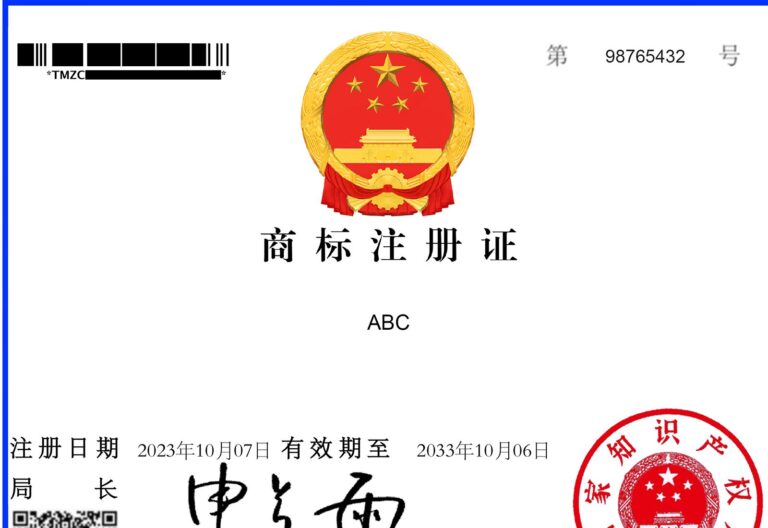
Trademark. China’s trademark law was first adopted in 1982 and subsequently revised in 1993 and 2001. The new trademark law went into effect in October 2001, with implementing regulations taking effect on September 15, 2002. The new trademark law extended registration to collective marks, certification marks and three-dimensional symbols, as required by TRIPs. China joined the Madrid Protocol in 1989, which requires reciprocal trademark registration for member countries, which now include the United States. China has a ‘first-to register’ system that requires no evidence of prior use or ownership, leaving registration of popular foreign marks open to third party. However, the Chinese Trademark Office has cancelled Chinese trademarks that were unfairly registered by local Chinese agents or customers of foreign companies. Foreign companies seeking to distribute their products in China are advised to register their marks and/or logos with the Trademark Office. Further, any Chinese language translations and appropriate Internet domains should also be registered. As with patent registration, foreign parties must use the services of approved Chinese agents when submitting the trademark application, however foreign attorneys or the Chinese agents may prepare the application.

Copyright. China’s copyright law was established in 1990 and amended in October 2001. The new implementing rules came into force on September 15, 2002. Unlike the patent and trademark protection, copyrighted works do not require registration for protection. Protection is granted to individuals from countries belonging to the copyright international conventions or bilateral agreements of which China is a member. However, copyright owners may wish to voluntarily register with China’s National Copyright Administration (NCA) to establish evidence of ownership, should enforcement actions become necessary.

Unfair Competition. China’s Unfair Competition Law provides some protection for unregistered trademarks, packaging, trade dress and trade secrets. The Fair Trade Bureau, under the State Administration for Industry and Commerce (SAIC) has responsibilities over the interpretation and implementation of the Unfair Competition Law. Protection of company names is also provided by SAIC. According to the TRIPs Agreement, China is required to protect undisclosed information submitted to Chinese agencies in obtaining regulatory approval for pharmaceutical and chemical entities from disclosure or unfair commercial use. China’s State Drug Administration and Ministry of Agriculture oversee the marketing approval of pharmaceuticals and agricultural chemicals, respectively.

There you go.  All true.

Comments

I am constantly amazed at the sheer amount of facts to be found on CLB. It's like doing a law course. I think you should give out degrees to long-time readers :)

It's interesting that it doesn't mention the duration of copyright protection in China. I think it's 50 years after first publication in China while copyright doesn't seem to be expiring in the US. Also, software patents are still an undecided subject in China and the bill for software patents were rejected in Europe last year. Both are touchy issues between US and the rest of the world.

Kevin S.

It is true that we seek to amaze, but grant degrees? I have a better idea. Our readers should be required to buy us food and drink.

In the US (per the US government copyright site), copyrights last for the author’s life plus an additional 70 years after the author’s death. In the case of “a joint work prepared by two or more authors who did not work for hire,” the term lasts for 70 years after the last surviving author’s death. For works made for hire, and for anonymous and pseudonymous works the duration of copyright will be 95 years from publication or 120 years from creation, whichever is shorter.

In China, copyrights typically last for the life of the author plus 50 years or, in some other instances for 50 years.

I would just like to echo the above statements about how great this site is for facts.

Also, here is a video of Disney characters explaining American copyright. I'm not lawyer, but I believe it is accurate.

http://freegovinfo.info/node/1204

chris (a/k/a Red Kemp, a/k/a Lawrence Taylor) --

Thank you, I think. I say "I think," because I would like to think I impart some analysis along with the facts.

That is a great video. I have a couple of thoughts on it:

1. I swear I have seen every single movie in it. Guess having a 9 year old and a 16 year old and loving movies as much as I do will do that to you.

2. Is this a copyright violation?

Chris,

That's awesome! Thanks for the video.

Dan,

I think there is no copyright infringement there thanks to the Fair Use in the US copyright system. Fair Use has come under massive attack in the states in the recent year, specifically with the DMCA (Digital Millennium Copyright Act).

Speaking of Fair Use, it seems that China's copyright system has adopted the similar principle and makes unauthorized distribution of copyrighted materials for educational purpose legal. It's funny to see the pirated DVDs with opening credits to several of the translation websites and a disclaim saying "This material is for personal English learning purpose only!" ;)

David Li --

You are probably right. I am certainly no expert in US copyright law.

I actually did not know that about educational uses circumventing China's copyright laws. I will look into that.

Post a comment

(If you haven't left a comment here before, you may need to be approved by the site owner before your comment will appear. Until then, it won't appear on the entry. Thanks for waiting.)


http://www.chinalawblog.com/cgi-bin/mt/mt-t.cgi/1945

China IP -- The Best Protection Is Prevention: